Two boxes of deep-filled mince pies -- check! Frozen turkey dinner -- check! Bottle of 'champagne' -- i.e. cheap sparkling plonk -- check! Figgy pudding -- check! One cracker to pull with oneself (yes, I am sad) -- check! One copy of Bob Dylan's new hot waxing Christmas in the Heart -- check!
I'm all set for my best Christmas ever -- i.e. one without relatives.
Yes, just when you thought there was no other major cultural impact for His Bobness to have, having turned rock music from teenage pap into an art form, having made country cool, having brought poetry to the juke box, having messed with religion and women's knickers, having sung a knock-knock joke, and having written a song with Michael Bolton done lots of other cool things, the Mighty Bob has decreed that Christmas shall henceforth be celebrated in October!
The younger generation were quick to heed the call -- behold this similarly entitled offering, released the same day (today):
am reliably informed that this wee leprechaun is the most recent winner of American Idol, cunningly disguised as a diminutive fawn. I know whose voice I prefer...
I think this that Christmas in the Heart is the greatest album ever released on October 13th 2009 (sorry, David Achoochoo fans). And just what the world needs in the middle of a depression -- turning the clock back to good times and partying like it's 1955! It's cheesy, it's cheery, it's addictive and probably very bad for you -- just like Christmas itself in fact!
Folk, Blues, and Beyond is one of those albums that changed the musical direction of a generation and is still cited today by anyone who really aspires to play the acoustic guitar. Most people find him, as I did, as a result of familiarity with the great Bert Jansch. Now I suppose the connection is at one more remove, but Bernard Butler, who worships Jansch, certainly knows him. And I suppose the proto-emo pissings of Neil Drake are where most younger people would have heard the influence of Davey Graham, even if they were unaware of it.
But everyone knows at least one tune of Graham's, Angi, as a result of its being covered by Paul Simon (who changed the spelling to Anji) and many others.
After the 60s Graham basically lost the next 30 years or more of his life to drugs, but he had returned to playing in recent years. A good job was done of issuing some of his old albums at the beginning of this century. They also issued "After Hours", recorded in a student's room at Hull University in 1967 after Graham's performance there the same evening. This is one of my favourite recordings by Graham. That's the sort of setting where you hear real music that no producer has sprinkled with so-called magic dust. Its release was a shot in the arm for anyone who's ever played a "concert" in someone's bedsit or student digs (I've spent some of the most enjoyable musical hours of my life in those settings).
Nowadays aspiring musicians make digital recordings on computers and upload them to MySpace. Graham belonged to that generation of musicians who paid their dues by busking their way around Europe (Ralph McTell is another guy who learned his trade this way, busking in subways or near cinema queues. McTell learned ragtime from a young American who'd studied with the legendary Gary Davies whom McTell met while busking on a freezing cold day on the Left Bank in Paris; you just don't get that sort of experience from the internet).
Graham's travels also took him to India, where he became one of the first British musicians to come under the spell of Ravi Shankar and Indian music generally (see under Harrison, George). Graham was one of the founders of British "folk baroque", which mixed American blues and English folk, renaissance and early classical music, plus what was not then, but is now called "world music." Thus we have lost not merely a fine musician, but a true pioneer.
At least we still have Bert Jansch, who now can quite properly be said to be the finest living British acoustic guitar player, a controversial claim while Graham was alive.
1. Two Little Boys. The children's classic that has a strange effect on grown men (and on a certain evil ex-prime minister). The real greatest single ever made!
2. Didgeridoo vs. harmonica -- I mean, which is cooler?
Well, ok, but which is more phallic?
3. Bob can't play the wobble board either.
4. His Rolfness has been backed by all four Beatles on a remake of 'Tie Me Kangaroo Down' sport -- Bob has only ever sung with George and Ringo, separately, and has never sung about kangaroos.
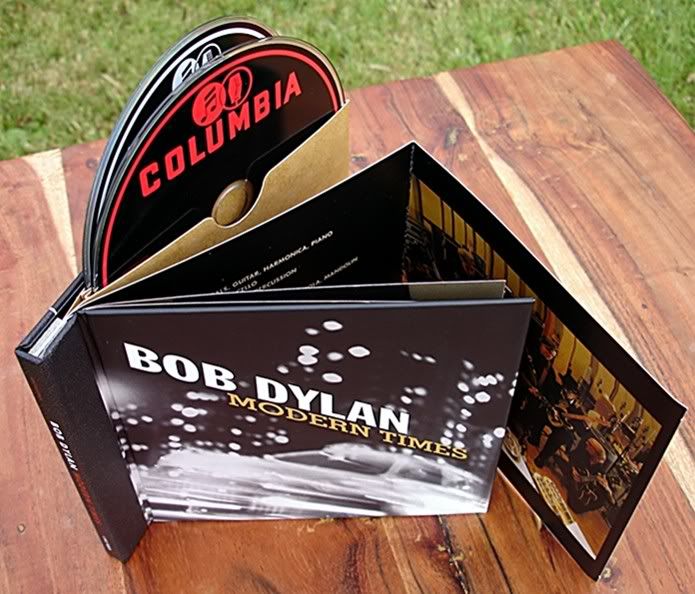
One thing I neglected to mention in my previous blog entry about Modern Times is that its worldwide official release day was also the first anniversary of Hurricane Katrina making landfall in Lousiana. Meanwhile, President Bush strummed a guitar [right] in California while New Orleans drowned, a lasting symbol of his presidency.
Perhaps the release date of Modern Times was a coincidence; but on the other hand, it does feature a song entitled The Levee's Gonna Break. This is the album's most transparent "borrowing", the song clearly deriving from When the Levee Breaks by Kansas Joe McCoy and Memphis Minnie, which was about the Mississippi Flood of 1927, a calamity that inspired several blues songs. (Incidentally, Memphis Minnie's shout-out to Ma Rainey is the model for Dylan's name-dropping of Alicia Keys in Thunder on the Mountain; but Bob was sampling Memphis Minnie as far back as Stuck Inside of Mobile With the Memphis Blues Again, as the outtake of that song released on Bootleg Series 7: No Direction Home shows.) A youtube user has made a very appropriate video to the Kansas Joe/Memphis Minnie version.
The most famous version of the song is the one by Led Zeppelin on their 1971 album Led Zeppelin IV. Dylan's new version is a curate's egg; it quotes some lines directly from the original, and adds some of his own that might refer to either the 1927 or the 2005 disaster:
Everybody saying this is a day only the Lord could make
Some people on the road carrying everything that they own
But other lines are unrelated and could be sampled from a dozen blues songs or improvised randomly in a way reminiscent of 10,000 Men on Under the Red Sky. One line seems to allude sarcastically to the plight of the proletariat (in the manner of Joe Hill's "Pie in the Sky When You Die"), thus harking back to Workingman's Blues #2:
Few more years of hard work, then there'll be a 1,000 years of happiness
But the previous lines incongruously refer to Carl Perkin's rockabilly classic "Put Your Cat Clothes On", cat clothes of course being what hepcats (guys) and kittens (chicks) wear; the juxtaposition with the more formal-sounding "evening dress" is amusing.
Here's a fine live version of Dylan's version of the song, from Chatillon, Italy 18th June this year: It's noticeable how much stronger the song has become in live performance this year.
How typical that Dylan's new title for the song should use his own favourite tense, the immediate future ("gonna"), which he uses so much (particularly in the Basement Tapes era) that it might well be called the Bob Dylan tense.
An early song that uses this tense is A Hard Rain's Gonna Fall. On his visit to the city in 2003, Bob Dylan performed an inspired version of this anthemic song, almost as though he knew what was in store for the city (so it seems with hindsight, which can make a prophecy out of the slightest coincidence). Here is that performance.
They're trying to wash us away
A more recent song about the 1927 flood became suddenly topical in 2005 because of the inevitable parallels between President Coolidge's racist indifference to the plight of Lousiana flood victims and the criminal negligence of the Bush administration. The original version of Randy Newman's Louisiana 1927 is on his 1974 album Good Old Boys, perhaps Newman's masterpiece and an essential album in anybody's record collection. Here is Randy singing it at a benefit for the victims of Hurricane Katrina:
Incidentally, I am relieved, if not surprised, that Randy sticks to his original lyrics and uses the phrase "this poor crackers land." The contemptuous term "crackers" is similar to the more recent "poor white trash", and nails Coolidge's attitude to the flood victims exactly. Other versions of the song, such as Aaron Neville's, for reasons of misguided political correctness substitute a more neutral term ("farmers") that softens the original song's condemnation of Coolidge.
They say prayer has the power to help (Ain't Talkin')
As I write, people are being evacuated from New Orleans in preparation for the landfall of Hurricane Gustav, expected in the early hours of Monday morning. It is sincerely to be hoped that the city rides out this new storm and the levees hold firm this time. Of all the cities in America, New Orleans is the one I'd most like to visit, because of the richness of its musical heritage, the fame of its cuisine, and the celebrated conviviality of its people. Alas, I do not share Dylan's belief in the power of prayer, but my thoughts are with NOLA right now. If I were to frame a prayer, it might be like Lear's in the storm:
Poor naked wretches, wheresoe'er you are, That bide the pelting of this pitiless storm, How shall your houseless heads and unfed sides, Your loop'd and window'd raggedness, defend you From seasons such as these? O, I have ta'en Too little care of this! Take physic, pomp; Expose thyself to feel what wretches feel, That thou mayst shake the superflux to them And show the heavens more just.
Bob Dylan's 32nd studio album was released 29th August, 2006. It was greeted with almost universal critical praise, but how does it hold up two years later? And how have the individual songs fared in live performance?
Modern Times was released at the high point of a tide of critical praise that had been rising ever since Bob's brush with death in 1997 reminded critics, many of whom had been bashing Dylan's work since as far back as the release of Renaldo & Clara, that Dylan would not be always there for them to take for granted, and that we ought to celebrate his achievements while we still have him. With the subsequent release of the Grammy-winning Time Out of Mind there began a period in which Dylan's critical stock rose so high that nowadays he is in receipt of praise that is almost as undiscriminating as the critical brickbats levelled at him in the eighties and early nineties. One of the few dissenting voices in the general chorus of praise for Modern Times, Alex Petridis in The Guardian, wrote waspishly: "It's hard to hear the music of Modern Times over the inevitable standing ovation and the thuds of middle-aged critics swooning in awe."
Two years later it is even more apparent that Petridis has a point. A solid achievement, Modern Times must be counted a relative disappointment compared to its illustrious predecessor "Love and Theft", Dylan's finest album since Blood on the Tracks and Desire in the mid-seventies. The quality that "Love and Theft" had in abundance was Dionysian energy: so welcome after the ennui and existential angst that had marked all Dylan's work since Infidels. Indeed, this ennervating ennui really begins with Don't Fall Apart on Me Tonight on the album just mentioned:
I wish I'd been a doctor Maybe I'd have save some lives that have been lost Maybe I'd have done some good in the world 'Stead of burning every bridge I've crossed.
Fine lines, undoubtedly, but a Dylan who looks back, and especially one who looks back with such despair and disappointment, is an unrecognizable shell of the energetic, questing, Dionysian figure of his best work. By contrast on Blood on the Tracks the singer plumbs the depths of despair, but drags from it the Lear-like rage of Idiot Wind and with Buckets of Rain, learns Lear's lesson of Stoic patience also.
This existential ennui came in Dylan's late middle age at the end of a period of great creative achievement from 1974 through 1983, and from there on becomes the dominant note of his work; think of songs like When the Night Comes Falling From the Sky and Dark Eyes on Empire Burlesque and What Good Am I? , What Is It You Wanted?, and Shooting Star on Oh Mercy, in which Bob basically repeats the same mantra over and over: he knows no answers, he has no hope, he lives companionless in a world apart where "life and death are memorized." All these negative feelings reach their peak of artistic expression on Time Out of Mind, which contains what may be the most negative, nihilist line in his entire output:
Well my sense of humanity has gone down the drain Behind every beautiful thing there's been some kind of pain She wrote me a letter and she wrote it so kind She put down in writing what was in her mind I just don't see why I should even care It's not dark yet, but it's getting there
When I first heard the line I've marked in bold, I found it so upsetting and depressing that it took me a long time to appreciate the real artistic achievement of Time Out of Mind, which is to state in the starkest form yet the existential ennui that had been overpowering Dylan's work since the mid-eighties. In that sense, it performs the same function as did Watching the River Flow, which faced up to the loss of his muse in the midst of his domestic content with its disarming opening line: "What's the matter with me? I don't have much to say." A Dylan who doesn't care, who is indifferent to love and desire, and who relies on negativity to pull him through is not the Dylan who once declared "this music that I’ve always played is a healing kind of music" and who wrote Desire... never fearful Finally faithful It will guide me well across all bridges inside all tunnels never fallin’.
A spiritual sickness hangs over Time Out of Mind from its opening lines, and it is only reinforced by the album's grim focus on physical decay: scars that won't heal, flesh falling off the singer's face, every nerve so vacant and numb. When he sings "But my heart just won't give in", you get the sense that he only wishes it would. Highlands, which does have its moments of humour and relief, nevertheless leaves us with a portrait of the singer as an old man shuffling along the street, talking to himself, and envying the younger people from whose unselfconscious joys and laughter he is forever banished:
I see people in the park forgetting their troubles and woes They're drinking and dancing, wearing bright colored clothes All the young men with their young women looking so good Well, I'd trade places with any of them In a minute, if I could
So in the 14 years since Don't Fall Apart on Me Tonight, Dylan has gone precisely nowhere: still wishing he were living someone else's life, looking back with regret and despair.
The achievement of Time Out of Mind, as heretofore stated, is to state these negative feelings in unpredecentedly stark terms. But the album marks a dead end: he cannot go forward artistically by simply restating over and over these feelings of existential isolation, of negativity and regret.
That is why "Love and Theft" was such a spectacular achievement. It has an energy and vitality not heard in any Dylan song probably since Jokerman and the brilliant, underrated Tell Me in the Infidels sessions. Gone is the companionless, misanthropic singer of Dark Eyes, Not Dark Yet, and Highlands; the singer on this album shows himself still receptive to feelings of love, friendship, and gratitude:
Well my ship's been split to splinters and it's sinking fast I'm drownin' in the poison, got no future, got no past But my heart is not weary, it's light and it's free I've got nothin' but affection for all those who've sailed with me
(Of course, these lines are from Mississippi, which was written for the Time Out of Mind album; and that album's atmosphere of bleak misanthropy and spiritual ennui would have been considerably relieved by that song's inclusion, as Dylan intended. Unfortunately, he and producer Daniel Lanois could not see eye to eye on the song's production, and so the song was dropped from the album. The original recording of Mississippi is to appear on the forthcoming Bootleg Series collection of outtakes, Tell Tale Signs.)
Best of all, perhaps, is the brilliant jump blues Summer Days, a song that could not have appeared on Time Out of Mind. In contrast to the despairing resignation of Not Dark Yet, which dolefully accepted that "it's not dark yet, but it's getting there", the singer of Summer Days reminds us of Dylan Thomas's "Do Not Go Gentle Into That Good Night":
Do not go gentle into that good night, Old age should burn and rave at close of day; Rage, rage against the dying of the light.
But rather than raging against the dying of the light, the singer of Summer Daysdances against it, leaping on the table to propose a toast to the King, and declaring that though summer days and nights are gone, that doesn't mean that there is no more fun to be had. The Dionysian energy of this singer is more like the Dylan we know of old, one busy being born rather than busy dying.
The energy, high spirits, and perhaps most welcome of all, the humour of "Love and Theft" made it Dylan's finest album for over 20 years. It sparkles with wit, and contains more quotable lines than any album since Street-Legal. It was perhaps too much to hope that Modern Times could equal this standard. But refreshingly, there is no relapse into the doldrums of most of Dylan's post-Infidels output. Most welcome is the extension of Dylan's musical palate beyond his usual reliance on blues and ballad forms, although there are some disappointingly generic blues shuffles on this album also (a couple of which border on musical plagiarism). Not since the underrated Shot of Love has Dylan dipped so much into the rich waters of American popular music. A particular source is pre-rock pop of the twenties to the fifties. Bing Crosby is a particularly strong influence; "When the Deal Goes Down" is musically a chord-by-chord recreation of Bing's "Where the Blue of the Night Meets the Gold of the Day" and "Beyond the Horizon" lifts the tune of "Red Sails in the Sunset." Moreover, Bing's version of "Brother, Can you Spare A Dime?" (played by Bob on the Theme Time Radio Hour show "Rich Man, Poor Man") hangs over Workingman Blues #2. How much love and how much theft lies in all these borrowings has been furiously debated.
One of the most pleasing aspects of "Love and Theft" was its cheerful sexuality, as in the artful suggestion of waning potency in Summer Days: My dogs are barking, there must be someone around My dogs are barking, there must be someone around I got my hammer ringin', pretty baby, but the nails ain't goin' down
or this saucy invitation in High Water (for Charley Patton):
Got a cravin' love for blazing speed Got a hopped up Mustang Ford Jump into the wagon, love, throw your panties overboard
And best of all, this allusive third-person reference:
Last night 'cross the alley there was a pounding on the walls It must have been Don Pasquale makin' a two a.m. booty call
Don Pasquale is the eponymous character in Donizetti's opera buffa, based on the commedia dell'arte archetype of the vain and foolish old man who tries to thwart the young heroine's love for the hero by marrying her himself. With a touch of comic genius Dylan has this stock character paying a "2 a.m. booty call"; and the pounding on the walls suggests that this Don Pasquale is no impotent figure of fun, but a virile figure capable of satisfying his younger lover.
By contrast, the sexuality on Modern Times comes over as idle boasting or even slightly creepy, as in the shout out to Alicia Keys in Thunder on the Mountain and in the unpleasantly sexist line "I want some real good woman to do just what I say" in the same song, in which the singer studies Ovid's Art of Love and proclaims "here's hot stuff here and it's everywhere I go." Unlike Don Pasquale who is getting on with it, paying his booty call, the singer of Thunder on the Mountain is just beating on his trumpet, or rather blowing his trombone (a rather obvious sexual metaphor).
Compare also the confident strut of Cry A While on "Love and Theft":
Well, there's preachers in the pulpits and babies in the cribs I'm longin' for that sweet fat that sticks to your ribs I'm gonna buy me a barrel of whiskey - I'll die before I turn senile
and the same song's earlier line about feeling like a fighting rooster with the much less convincing boast in Spirit on the Water:
You think I'm over the hill You think I'm past my prime Let me see what you got We can have a whoppin' good time
That corny and dated phrase "whoppin' good time" is the antithesis of Don Pasquale's ultra-hip "booty call" and rather deflates the intended boast. Rather than as the still virile aging stud that the singer intends to present himself as, he comes over more like a paunchy dad trying to dance at his daughter's wedding reception.
Dylan does improve this verse considerably in concert by singing the first two lines as questions, with an implied "Oh yeah?!", invariably getting a reaction from the audience. And this viagra-induced boasting is at least an improvement on the indifference to desire manifest on Time Out of Mind.
Another weakness of Modern Times compared to its predecessor is its rather precious and somewhat stilted lyricism that at times borders on Victorian pastiche, especially in the parlour ballad When the Deal Goes Down and Spirit on the Water. This may be due to Dylan's falling under the spell of the Civil War poet Henry Timrod (reflected in several borrowings from the earlier poet's work). Compare the freshness of these lines from Moonlight:
The clouds are turnin' crimson The leaves fall from the limbs an' The branches cast their shadows over stone Won't you meet me out in the moonlight alone?
The boulevards of cypress trees The masquerades of birds and bees The petals, pink and white, the wind has blown Won't you meet me out in the moonlight alone?
The trailing moss and mystic glow Purple blossoms soft as snow My tears keep flowing to the sea Doctor, lawyer, Indian chief It takes a thief to catch a thief For whom does the bell toll for, love? It tolls for you and me
where the self-conscious poeticism is relieved by Dylan's familiar tricksy rhyming ("crimson", "limbs an'") and the admixture of nursery rhyme and familiar quotation; with
I picked up a rose and it poked through my clothes I followed the winding stream I heard the deafening noise, I felt transient joys I know they're not what they seem In this earthly domain, full of disappointment and pain You'll never see me frown I owe my heart to you, and that's sayin' it true And I'll be with you when the deal goes down
which undoubtedly have a certain charm, but border on pastiche.
Against this, Modern Times has strengths of his own. It is much better sung than its predecessor (though the musicianship is not of a similarly high standard), and its three best songs are outstanding. The first, Workingman Blues #2, is the closest the album gets to evoking the spirit of Charlie Chaplin's Modern Times. The song features some of the strongest, most evocative writing of the album, for instance, in this reminder that all of us, rich or poor, walk in the valley of the shadow of death:
The opening lines seem to have an extra topical relevance as the world's economy goes into recession:
There's an evenin' haze settlin' over the town Starlight by the edge of the creek The buyin' power of the proletariat's gone down Money's gettin' shallow and weak The place I love best is a sweet memory It's a new path that we trod They say low wages are a reality If we want to compete abroad
However, this is no rewrite of North Country Blues or Hollis Brown. Its narrative element is non-linear and its protagonist's situation more complex; whoever the singer is supposed to be, he is hardly the typical working man. Dylan is unlikely to usurp Springsteen's status as the poet laureate of the blue collar worker. It's a complex song full of strong images, memorable lines, and with a rousing chorus.
Even more impressive is Nettie Moore, one of Dylan's great ballads, and a song that he has invariably interprets powerfully in concert. A notable feature of the song, despite its folk ballad form, is its saturation in the language of the blues. The opening line quotes the old song "Lost John":
Lost John standin' by the railroad track Waitin' for the freight train to come back
while later lines evoke the famous story of Frankie and Albert. The crossroads where Robert Johnson is said to have sold his soul to the devil is also evoked. As with many of Dylan's recent songs, it is difficult to say what this collage of recollected and original lines means, but the song is undoubtedly highly evocative.
And finally, the album's closer Ain't Talkin', a mysterious and somewhat sinister epic that returns us to some extent to the atmosphere of Time Out of Mind. The claim that Modern Times was the final album of a trilogy stemmed from his record label rather than the artist himself; in fact, Dylan has specifically denied it. Nevertheless, this dark tale of a man walking, walking, walking, until he reaches the edge of the world (which he appears to doubt is round as men say) brings us full circle to the earlier album, which opens with the words "I'm walking..." and thereafter uses the image of the singer walking "a thousand miles from home" (or rather a million miles) repeatedly as a symbol of his isolation from society. The song begins with a reminiscence of the story of Mary Magdalene mistaking the risen Christ for the gardener of the grounds; but this "mystic" garden is a place of violent menace where "wounded" flowers hang from the vine and the singer is struck from behind. The singer himself threatens to slaughter his enemies if he ever catches them sleeping. He is not alone (which separates him from the isolated figure of TOOM, who seems more of an autobiographical than the mysterious narrator of "Ain't Talkin'), but accompanied by a band of brothers who "share my code", a faith that's long been abandoned, as he walks through a world of hostile infidels and "cities of the plague". The song raises more questions than it answers, and when the narrator steps off the end of the world in the song's final lines, we still have no idea who he is supposed to represent. Several lines in the grim discursive narrative are borrowed from Ovid's self-pitying letters from his exile on the Black Sea, the Tristia, but the story seems closer to Homeric epic than classical elegy. Although it raises more questions than it answers, as a performance it is gripping, full of menace, horror, and intensity.
I leave you with videos of these three songs, each of them a classic of the modern Dylan.
Workingman Blues #2 was a song Bob found difficult to make effective in its first year of live performance. It wasn't until the Australian tour of 2007 that the song really came into its own. It is now a regular concert standout. The following video is identified only as "live 2008"; great sound, though poor video.
Here's a fine Nettie Moore from 2006:
And here's my favourite performance of Ain't Talkin' (Melbourne, Australia 19th August, 2007):
Last October BBC radio broadcast "Dream Dylan Live", a show featuring 10 live performances from across the years cobbled together into a "virtual live show."
In truth, this would have been few people's "dream" concert in the sense of the ideal live Bob Dylan show. On the other hand, the show accurately conveyed the impression of "a series of dreams"— random and unconnected performances each making a strong, vivid impression, but offering no coherent raison d'être.
Only two tracks were unknown to collectors. I may have been the first, on a Dylan internet forum at least, to suggest that Blowin' in the Wind and Only A Pawn in Their Game from this programme could have been from Dylan's Carnegie Hall concert of 23th October, 1963.
This suggestion was pure conjecture, no more than educated guess on my part, based purely on the fact that the 1963 Town Hall and Carnegie Hall concerts are known to have been recorded by Columbia; a live album culled from the two shows was prepared for release in 1964, and then aborted, for reasons that remain unclear.
Both 'Blowin' in the Wind' and 'Only A Pawn in Their Game' were performed at the Carnegie Hall concert. In 2005, Sony-Columbia released two songs from the Carnegie show on Bootleg Series 7: No Direction Home, and a further six songs on a bonus disc available to purchasers of the Bootleg Series CDs and the Bob Dylan Scrapbook. So it seemed natural to deduce that the two songs donated to the BBC for 'Dream Dylan Live' were among those considered but rejected for release in 2005. (Why not just release the whole concert already? It's a far better performance than the 1964 Halloween Concert released as Bootleg Series Vol.6.)
To my consternation, my conjecture was immediately circulated as fact. Apparently the rest of the Dylan community were thinking on the same lines as I. Nevertheless, in the world of Dylan collccting, things have rarely been as they have seemed. A few months ago, the bootleg label Hollow Horn finally ended Columbia's 45-year striptease with regard to this show (unveiling a track or two every so many years) and released this historic show in its entirety, and in stunning quality. This followed the final release of the even more historically important Town Hall concert a few months earlier.
I've been much too busy to compare the performances of Blowin' and Pawn on the Hollow Horn release with the Dream Dylan Live performances until now. In fact, I just assumed that my initial guess was right.
Well guess what—I was only 50% on target! The DDL Blowin' in the Wind is indeed the Carnegie Hall one. There are at least two fairly conclusive fingerprints that establish this identification. In the first place, Bob sings "How many times can a man turn his back" rather than the more usual "turn his head." And he adds a word in another line: "How many times must a man look up/Before he can really see the sky..."
However, "Only A Pawn in Their Game" is NOT the same performance! This is pretty obvious, because in the Dream Dylan Live performance, after the lines "The deputy sheriffs, the soldiers, the governors get paid/And the marshals and cops get the same" Bob forgets the lyrics and sings a garbled version of the rest of the verse!
So we have a bit of a mystery. This is quite clearly a 1963/4 performance, but does not correspond to any known performance. It's not the Greenwood, Mississippi version (the live debut), the Lincoln Memorial version, or the version that was performed live on WNET 30 July, 1963. Nor is it the version from Philadelphia, 28th Sept, 1964. My best guess is that it could be from one of the Newport Folk Festival concerts/workshops. But it's definitely not the 26th July evening performance, which was released last year on The Other Side of the Mirror. So the question remains: what other show from this period was recorded by Bob's record company? I am thinking Royal Festival Hall, London 17th May, 1964, two tracks from which emerged on the "Fantasy Acetate" a few years ago. But for goodness sake, don't quote me on it this time! (It still sounds more like a '63 performance to me, and I'm sticking with my guess of an unchronicled Newport performance...)
It should be obvious that the above two versions of the same song are different performances. Goodness knows why Bob's people decided to give the BBC a flawed performance when they had the faultless Carnegie Hall one....
Note: mp3s on this blog have each been downloaded over 200 times; no one has yet said thank-you. In lieu of thanks, I would be grateful if a few of you could click on the Google ads on this page. I earn a few cents per click, which enables me to stay on line! Thank you in advance!
I shall be posting mp3s of the other unofficially released Carnegie Hall tracks in due course.
Left: Falconet's statue of Peter the Great, who built St. Petersburg as his "window on the West."
For the first time in 30 years I am able to combine my day job (as a translator of the Russian press) with one of my main hobbies (appreciation of the music of Bob Dylan). So to follow up on my blog the other day, in which I translated the review of a highly perceptive Russian beat fan, here is a look at what the Russian press had to say about Bob's recent concert in St. Petersburg.
Right: bootleg art by StewART.
It was Peter's city, or rather the great poem about it by Alexander Pushkin, "The Bronze Horseman", that inspired me to take up the learning of Russian 30 years ago. Peter built his city in spite of nature, at an enormous cost in human life, as his "window on the West" through which he hoped Western culture would pour, enabling him to rouse up Mother Russia from what he perceived as her oriental backwardness, symbolised in Falconet's statue (above left) by the snake beneath the feet of Peter's fiery steed as he rears it up before the abyss on its giant pedestal, the Thunderstone, sometimes said to be the largest stone ever moved by man. To this day "Peter", as the city was known to its habitants even in Soviet times when it was officially named Leninngrad, remains the most Western of Russian cities, and hence, as the Russian website fontaku.ru notes, much more suited to Bob Dylan than the "white stone city" (i..e. Moscow), where Bob performed three songs at an invitation-only poetry festival way back in 1985.
The Russian press is, as regards youth culture, like the British and American press of 40 years ago; it claims to speak for the fans, but rarely makes any attempt to canvass their opinion. Whereas the admirable beatgene stated quite clearly that she hadn't expected Bob to perform her favourite songs, Kommersant (one of the few bastions of independent journalism remaining in Putin's Russia) assumes that the fans had been expecting the most familiar Dylan songs, and that Bob was guilty of showing contempt for the St. Petersburg public by not performing them.
The setlist looked as if the the maestro had no idea of where he was playing, or before whom. Or else he sincerely and entirely didn't give a damn. Fans of Paul McCartney, for instance, have seen him perform twice already on the territory of the former USSR, and only now are able to permit themselves to timidly ask the idol to play at his concert in Kiev on 14th June one or two things apart from a gentlemanly selection of "greatest hits." From the point of view of world culture, Bob Dylan is a figure of equal weight, but he was performing here for the first time since 1985, for the first time since an unsuccessful performance before an ideologically irreproachable and absolutely indifferent audience at an evening of world poetry that was timed to coincide with the Festival of Young People and Students in Moscow. To all intents and purposes, the concert in the Ice Palace was his first proper performance in this country. And he comes onto the stage and sings the following collection of songs:
"Cat`s in the Well" from the 1990 album Under the Red Sky. "Don`t Think Twice, It`s All Right" and "Girl of the North Country" from The Freewheelin` Bob Dylan (1963). "Honest with Me" from "Love And Theft" (2001). And seven of the 10 songs on the 2006 album Modern Times.
No one expected Mr. Dylan to perform a programme consisting only of songs from his "best of" collections; clearly he is still promoting his universally very well received album "Modern Times". But take the 2007 three-CD collection "Dylan", a more thorough compilation than many "best of" CDs, based as it is not just on the sixties golden period. Of the songs enumerated above, only one is on this compilation—"Don't Think Twice, It's All Right." In other words, for his début in Russia, Mr. Dylan chose songs that aren't too well known anywhere in the world. At least that was the concert blueprint by and large: to play the little-known and completely new. But he nevertheless did offer a few of his calling cards. "Just Like A Woman" and "Highway 61 Revisited" were there, and the final number was the song that comes to mind when you figure out how Bob Dylan should end his concerts—"Like A Rolling Stone. But if "Just Like A Woman" was performed with at least some kind of hint at the possibility of singing along with it, the two other hits were played as if deliberately without even the most minimal hook that an audience wishing to express their respect for a classic could latch on to.
This quality of "podpevayemost'" (literally 'being able to sing along with') appears important to Russian audiences: beatgene herself mentioned being surprised and disconcerted by its absence. Is this what one goes to rock concerts for in Russia? To sing along with the songs just as they are on your records (or illegal downloads, more likely) at home? At any rate, this is not a quality that many songs as performed on the Never Ending Tour, or at any other stage in Bob's career, have had. He is not interested in being "the legend", or in the Russian phrase, "a classic" demanding respect, but in recreating his songs according to his current whim. Nevertheless, as this is likely to be his one and only performance before a Russian paying audience, I can't help wishing that for once the old bastard had been willing to acknowledge where he was and meet the audience half way. Russians do have an almost religious reverence for poets and performers, and they do like to indulge this bardolatry wherever possible. Their troubled history of the Russian people has meant that artists and poets in Russia have always carried the burden that Bob shook off early on in his career; that of expressing the true thoughts and feelings of the people. But they revere the poet for his words, not for his fame or whatever goes on in his private life. Should Bob have forgotten the lyric sheets that of late have become a fixture on his keyboard, there is little doubt that the entire audience would have been able to prompt him, in thick Russian accents, of course, just as readily as they did me when, at some dinner party or other in Moscow 20 years ago, I attempted to recite a poem by Aleskandr Blok while fully loaded on bootleg vodka and forgot some of the words. Everyone in the room joined in reciting the long dead poet's words.
Just who was the audience for this particular show, apart from beatgene and her fellow beat fans, as we have seen? According to fontaku.ru it was
a curious symbiosis of members of the older generation and young people. There were hippies and kids in trendy gear. What didn't happen was any sense of a "crowd." It was perfectly obviously that each of the spectators had his own Dylan, his own history of relations with his songs, it was impossible to speak of any kind of mass concert ecstasy. The audience was predominantly male, and the women were from the intelligentsia category. There were no "dumb blondes." Many spectators, with serious-looking faces, whispered the words of the songs in English; there were quite a few foreigoners. You would thing that such a tedious concert would quickly become boring; after all, nothing was happening outwardly on state; but there was in both a musical and poetic sense. internal drama. The sound was not loud; it was even like chamber music; but the band played with impeccable style. And for a man of 67, Dylan sung very well: the timbre was clear, the voice strong, even, and far more powerful than on the records.
A rather tepid review; and yet, considered as just another show by the modern Bob Dylan, the St. Petersburg concert was actually pretty good, on the evidence of the already circulating recording by the ubiquitous taper who goes by the name of Bach (hence the inevitable "Bach in the USSR" jokes). As on the US and Canada leg of the tour, Bob is in very good voice, and the performances are anything but indifferent. The band is even coming to life a bit, with noticeably more dynamic solos by Denny Freeman. Although it would be stretching things to suggest that the setlist was in any way tailored toward the audience, it's possible to imagine that Girl of the North Country was chosen as a tip of the hat to the "Venice of the North", as the city of Peter the Great is often called, or even to the name of the venue itself. And Workingman Blues #2 would have struck a chord with many in a nation that has gone from a drab, but equitable socialism, to an unbridled form of capitalism in which the rich are very wealthy indeed, and the poor can barely make ends meet. The buying power of the proletariat has certainly declined since Soviet times (when there was nothing to buy, but all necessities were dirt cheap). Modern times in Russia are very hard for a large percentage of the population.
Nevertheless, Tangled Up in Blue was in the setlist as if to remind everyone that Russia was just "another joint" on Dylan's endless road (or it could be because it was one of the songs written under the influence of Dylan's Russian-born art teacher, the mysterious Norman Raeben; or even just because it is the only Dylan song that mentions revolution!). It's a shuffling, bluegrass-tinged version with some new, somewhat half-baked lines:
He drifted down to New Orleans where he was lucky enough to be employed Three times on a sailing boat, three times it was destroyed
Ouch. Rather better are:
She was working in "the Tropicana" I stopped there for a beer I told her I was goin' on later (?) She said, "I'm gonna stay right here."
Bob whips out the ol' harmonica before and after the last verse. Altogether a more enjoyable version than some of the breakneck versions of the recent past. Other songs worth mentioning are Just Like A Woman, well sung with a lengthy harmonica intro; a smouldering rendition of It's Alright, Ma (I'm Only Bleeding) (Russians need no reminding that "propanda, all is phony"), with Dylan's keyboards maybe higher in the mix than usual; and a mesmerising Ain't Talkin'.
Here are some mp3s, with thanks to the aforementioned "Bach":
[I'll skip the first few sentences; the writer of the review (who blogs on Live Journal under the name beatgene) is part of St. Petersburg's beat scene (Beatles and Kinks fans), and the first couple of sentences are about her arriving at Ledovyy (the Ice Palace) well before the start of the show and meeting up with other people she knew from her Beatles forum. She sounds a really sweet girl; a shame Bob couldn't have been be a bit more responsive to his Russian fans.]
They were allowed in at 7pm: "I was in the second row of the orchestra stalls, pretty cool. But this is where the bewilderment started—the crowd didn't particularly increase. That is to say, there were around 150 of us standing in the stalls with the proverbial one-and-a-half cripples. By the start of the concert, we were feeling awkward about the far from full hall. Heck, Bob Dylan himself has come! For the one, and most likely, the only time. The entire Ledovyy department that was involved in promoting the concert should be fired as effing useless. Along with the security, who, seeing me focusing my camera lens on the as yet empty stage, sternly reported that photographs were strictly forbidden, all complaints [should be made] to the organizers. "Carry on taking pictures for now, kids; but when the concert starts, you won't be allowed to continue."
And now about Bob.
I'm a clever cookie, I don't think I expected from him fiery speeches, shouts of "Hiya, kids!", and the songs of his I love. The one thing I didn't count on was that he would change the arrangements of some numbers so much. No, they sounded good. Interesting. Only in places, unrecognisable; it was possible to sing along only with Just Like A Woman and Like A Rolling Stone. Well, for me anyway.
As everyone knows by now, Bob played only keyboards and harmonica.
Setlist:
1. Cat's In The Well (Bob on keyboard) 2. Don't Think Twice, It's All Right (Bob on keyboard) 3. Rollin' And Tumblin' (Bob on keyboard) 4. Tangled Up In Blue (Bob on keyboard) 5. The Levee's Gonna Break (Bob on keyboard) 6. Girl Of The North Country (Bob on keyboard) 7. John Brown (Bob on keyboard) 8. Honest With Me (Bob on keyboard) 9. Just Like A Woman (Bob on keyboard) 10. It's Alright, Ma (I'm Only Bleeding) (Bob on keyboard) 11. Workingman's Blues #2 (Bob on keyboard) 12. Highway 61 Revisited (Bob on keyboard) 13. Spirit On The Water (Bob on keyboard) 14. Summer Days (Bob on keyboard) 15. Ain't Talkin' (Bob on keyboard) (encore) 16. Thunder On The Mountain (Bob on keyboard) 17. Like A Rolling Stone (Bob on keyboard)
There was a tense atmosphere; either Bob was tired or didn't especially like the St. Petersburg public. I didn't fully understand it, but he smiled little, spoke even less, came out for one encore, bowed, and left. And for the first time I clearly understood right away that they wouldn't return [for a second encore]. Even with Chuck Berry I had some hopes.
But this time... I don't even know what the reason was, whether it was general tiredness from concert performances, the far from full hall, or some other reason.
But all the same he's a big shot. All the same, he's a legend. And people love him. Standing nearby us were a little group of sweet Italians who devotedly follow Dylan round all the towns where he plays—real fanatics. Probably Russia appearing on his itinerary surprised them a bit!
And they still wouldn't let me take pictures. I thought that I 'd got into position successfully—the security man in front of me didn't see, I started snapping without a flash. It should have worked out fine. But it turns out, they [security] rushed down from the stage area. As a result, a security guy managed to get to me from behind and politely invited me to stop.
A few shots remained. I feel ashamed about showing them, of course, but what can you do—there won't be another time, as I understand. No, I didn't take them on a cell phone.
Well, that is that. My impressions are truly mixed. They don't fit into the usual rubric of liking or not liking something. I went to see Bob Dylan. I saw him. And I'm very happy indeed with this. Thanks to him for coming. And thanks to infobeat [name of another Live Journal blogger] for getting Bob to make a peace sign in his direction. It melted his icy heart. [There is a pun here on the name of the venue, of course].
Well, beatgene, that's a nice review, and your photos are nothing to be ashamed about. I hope you don't mind me showing them here. I hope this translation is okay, I'm a bit out of practice with colloquial Russian; I haven't translated anything but financial and legal documents and technical specifications for a long time!
So another Dylan anniversary comes around, and no doubt Dylan fans everywhere will be playing his classic song Forever Young in his honour. Here then, are a few reflections on that timeless song and how its original message is often mangled, and even turned on its head.
Although Dylan successively negotiated the thin line between sincerity and sentimentality, the song was almost immediately turned by those who heard it from a father's pious wishes (or prayer) for his son into a mawkish expression of insincere sentiment on the part of young people for those of advancing years; like one of those horrible Hallmark Cards that say something like: "Happy Birthday, Dad! Seventy Years Young!"
This ghastly perversion of the song's original meaning reached a ne plus ultra level of well-meaning but mawkish sentimentality when the reformed Band (who, of course, with Robbie Robertson and Richard Manuel in their fold took part in the original recording of the song for Planet Waves) recorded the song for their High on the Hog album, dedicating it to…the late Jerry Garcia!
So I'd like to take another look at the song and explain why it is the very opposite of sentimental, and shouldn't be used as an excuse to wallow in flabby, mawkish Peter Pan-ism.
Here first are the lyrics, reproduced here from www.bobdylan.com for the purposes of study:
May God bless and keep you always, May your wishes all come true, May you always do for others And let others do for you. May you build a ladder to the stars And climb on every rung, May you stay forever young, Forever young, forever young, May you stay forever young.
May you grow up to be righteous, May you grow up to be true, May you always know the truth And see the lights surrounding you. May you always be courageous, Stand upright and be strong, May you stay forever young, Forever young, forever young, May you stay forever young.
May your hands always be busy, May your feet always be swift, May you have a strong foundation When the winds of changes shift. May your heart always be joyful, May your song always be sung, May you stay forever young, Forever young, forever young, May you stay forever young
There we have it: just three short verses and a simple refrain. However, this simplicity should not lead us to suspect simplemindedness. Allen Ginsberg considered it one of Dylan's finest songs, recognizing in it the apparently artless but pure expression of Blake's Songs of Innocence and Experience.
Dylan was quite clear of the dangers of expressing conventionally pious sentiment in popular song. In his interview with Cameron Crowe for the Biograph booklet he is quite explicit: "I wrote it thinking about one of my boys and not wanting to be too sentimental. The lines came to me, they were done in a minute. Sometimes that's what you're given."
The writing of the song may have been done with Dylan's habitual swiftness, but the recording process was very different. From Wikipedia:
After several false starts, Dylan and The Band executed what would ultimately be one of two master takes for "Forever Young." However, Dylan nearly rejected the performance after hearing some disparaging criticism from one particular visitor.
"We only did one [complete] take of the slow version of 'Forever Young','" recalls [Planet Waves producer Rob] Fraboni. "This take was so riveting, it was so powerful, so immediate, I couldn't get over it. When everyone came in nobody really said anything. I rewound the tape and played it back and everybody listened to it from beginning to end and then when it was over everybody sort of just wandered out of the room. There was no outward discussion. Everybody just left. There was just [a friend] and I sitting there. I was so overwhelmed I said, 'Let's go for a walk.' We went for a walk and came back and I said, 'Let's go listen to that again.' We were like one minute or two into it, I was so mesmerized by it again I didn't even notice that Bob had come into the room...So when we were assembling the master reel I was getting ready to put that [take] on the master reel. I didn't even ask. And Bob said, 'What're you doing with that? We're not gonna use that.' And I jumped up and said, 'What do you mean you're not gonna use that? You're crazy! Why?' Well, during the recording...[Dylan's childhood friend] Lou Kemp and this girl came by and she had made a crack to him, 'C'mon, Bob, what! Are you getting mushy in your old age?' It was based on her comment that he wanted to leave [that version] off the record."
Fraboni would defend the recording, and when he refused to relent, Dylan reconsidered and allowed him to include it on the album. On November 9th, Dylan held what he intended to be the final session for the album. From Fraboni's perspective, Dylan already had a perfect take of "Forever Young" from the previous day, but Dylan still attempted a different, acoustic arrangement, which was ultimately rejected. Dylan would tell Fraboni that afternoon, "I've been carrying this song around in my head for five years and I never wrote it down and now I come to record it I just can't decide how to do it."
Bob Dylan became a father for the first time in January 1966, when Jesse was born. Anna Lea followed in July 1967, Samuel July 1968, and Jakob in December 1969, which would postdate Forever Young's composition if Bob's claim to have been carrying the song in his head for "five years" before the Planet Waves sessions (November 1973) was literally true. This does seem a long time to put off recording a song that came to him so swiftly it felt like the gift of a higher power.
Perhaps in reality only the germ of an idea of the song had come to Dylan as early as that, and it was not completed until just before he made a demo of the song for Ram's Horn Music in June 1973. Otherwise it is difficult to believe that Dylan would not have attempted to record the song for so long, and would have included several inferior songs on New Morning instead. The latter album includes several songs that touch on the theme of fatherhood, so it can't be said that Bob was reluctant to think of himself in those terms or that the song would have been out of place on that album. New Morning even includes a prayer, which is what Forever Young ultimately is. Father of Night, however, with its evocation of oppositeis more of a Zen Buddhist prayers. (It could easily be a children's song, except there is a palpable moment when it turns from a song of innocence into a song of experience; namely the line "Father of loneliness and pain", at which point the song stops and there is a pause, not long enough to be agonizing ,but noticeable enough to be troublesome, before the final line of the verse brings the expected reassuring rhyme.)
Forever Young is more explicitly a Jewish or Christian prayer of the type known as a Benediction, pronounced by a priest on special occasions. By far the best known is the Priestly Blessing, which is based on Numbers 6:23-27:
The Lord bless thee, and keep thee The Lord make His face to shine upon thee, and be gracious unto thee The Lord lift His countenance upon thee, and give thee peace.
In Orthodox Jewish tradition, only the kohanim (priests, direct male descendants of Aaron, brother of Moses) can pronounce the Blessing, stretching his hands forth over the people. However, this blessing is also used by some parents to bless their children on Friday night before the beginning of the Shabbat meal. Some rabbis will say the blessing to a boy at his barmitzvah ceremony. Therefore in adapting the blessing for his sons (and daughter? the sentiments are strongly patriarchal), Bob was merely continuing the partial secularization of the priestly blessing that was already established in many non-Orthodox Jewish communities.
(On the other hand, a music concert is like a synagogue, or rather a cathedral, and the singer or star is the "kohen" or priest, extending his blessing to the audience/congregation. This is why the song is so effective in live performance, since for the duration of the show we all become Bob's children.)
"May your wishes all come true" isn't a bland statement, but a pious wish that every father makes for his children, even though he knows that nobody's wishes all come true (and therefore the father's wish is itself one that will not come true).
"May you always do for others and let others do for you." Ginsberg suggested (interview with Peter Barry Chowka in New Age, 1976) that this is "Dylan's hip, American-ese paraphrase of Christ's 'Do unto others . . .' But although the cadence is similar, the sentiment is quite different: Dylan wishes his sons to be helpful to others, but not too proud to accept help from others too.
The next line reminds us of the ladder Jacob dreamed of in Genesis whose top reaches to heaven. Dylan wishes his sons a ladder that reaches "to the stars"; but they will have to build it themselves, and climb on every rung. In other words, he does not want them to have any shortcuts to the top (riding on the coattails of their father's fame, for instance). But also he wants them to enjoy every stage of their ascent of the ladder, rather than just focusing on reaching the top.
The second verse is about the abstract qualities Dylan hopes his sons will have when they grow up. Note the deft shift from "being true" to "knowing the truth." Being true means being loyal (to one's family, friends, country, ideals etc.), while knowing the truth means not only being able to detect a falsehood, but (in a religious or philosophical sense) following the true path to enlightenment. Perhaps it is not too fanciful to see in this contrast between the ontological (being) and epistemological (knowing) Plato's contrast between right action and knowledge of the truth. The man who knows what is right, according to Plato's Socrates, will always do what is right. He who does what is right, however, without clear knowledge is in danger any moment of going wrong, and Socrates compares him to a blind man going along the right path.
"...see the lights surrounding you" is vaguer, but probably complements "…and let others do for you." Don't think you're all alone in this world, surrounded by darkness. Look around and see the light of others that will help you see your way along the true path. Courage, uprightness, and strength are traditional male virtues, which Dylan unabashedly recommends.
"May your hands always be busy"; because, as we know, "the Devil makes work for idle hands to do." This is example of Dylan deftly recasting a traditional piece of wisdom or an aphorism that has become a cliché in a new mold in order to make us think about it afresh. He does this elsewhere on Planet Waves: in Going, Going, Gone, "all that glisters is not gold" becomes "all that’s gold wasn't made to shine.
Hands lead naturally to feet, busy leads almost as logically to swift, with the same implication: don't be idle, don't waste your life doing nothing. But also there is the implication that if you do linger along the way, looking behind you instead of pressing on, you will find yourself left behind as time wreaks its inevitable changes ("He who gets hurt will be he who has stalled"). This thought is typical of Dylan, for whom the artist never looks back, and leads naturally to the song's most arresting image and a line that deliberately reminds us of at least two of the "young Dylan's" classic songs:
May you have a strong foundation when the winds of changes shift
This reminds us not only of Blowin' in the Wind, but even more strongly of The Times, They Are A-Changin', when Dylan had been on the other side of the generational divide, warning the older generation to get out of the way of the new and to take care lest they sink like a stone as the waters rose around them. Now on the cusp of middle age and having learned that he too must make way for a younger generation, he reminds his sons that they too will need to be very swift and very strong to avoid being swept away in the changes they too will inevitably face. This is extremely important, because at first sight the Dylan who wrote "Forever Young" seems very different from the younger man who wrote "The Times, They Are A-Changin'." The latter song was embraced as a clarion call for radical social change, while the former apparently espouses very traditional sentiments. But the message of the two songs is really the same: accept change, but don't be swept away by it.
This became fully apparent when on his 1978 tour Dylan sung "Forever Young" and "The Times, They Are A-Changin'" back to back at the close of the concert. The two songs illuminated one another. It became clear that "Forever Young" wasn't a collection of patronizing pieties, while "Times" wasn't so much about social change and the sixties generation gap as the inevitable cycle of history, the whirligig of time that brings in its revenges, in Shakespeare's phrase. After all, the song seems to draw on Tennyson's beautiful lines from Idylls of the King on the inevitability of change and decay:
The old order changeth, yielding place to new; And God fulfils himself in many ways, Lest one good custom should corrupt the world.
The line it is drawn and the curse it is cast The slow one now will later be fast As the present now will later be past The order is rapidly fadin'...
The phrase "winds of changes" is very beautiful in itself. The phrase originated in a speech by British prime minister Harold Macmillan in South Africa in 1960 that heralded a new era of decolonization. Macmillan's actual words were "The wind of change is blowing through this continent", but the phrase entered the popular language as "winds of change." Simply by making the second noun plural as well as the first, Dylan produces a wonderful piece of assonance and alliteration (since ds sounds very similar to the soft g in 'change', unlike the hard d in 'wind'), reinforced by the alliteration of w in "when the winds", so that the line first of all blows and then ripples as the vowels shift from e to i toa and then back to i again. In the Planet Waves recording (the slow version), Dylan further matches sound to sense by dragging out the vowel in "shift", so that it really feels as though the ground is moving under our feet. Has anyone else who has recorded this song been so alive to these nuances? Only Dylan, and perhaps only in that great recording Fabrioni so rightly cherished and championed.
It may be objected that "shift" is an awkward choice of verb, because winds don't shift: foundations do if they are not sufficiently strong, and sands shift in the desert winds. But somehow the line, perhaps because of the way Dylan stretches it out and animates it with his singing, seems to encompass all these meanings without conflict.
Finally we come to the line that fully encapsulates what the real meaning of the wish "may you stay forever young" encompasses. Dylan is not talking about being trapped in a Peter Pan type warp like those ageing baby boomers whose tastes and behaviour have remained perpetually adolescent, but about being "young at heart", a cliché that he, thankfully, deftly avoids, singing instead "May your heart always be joyful." Thus youth and joy are associated; and only with joy in our hearts can we still be youthful despite our ageing bodies.
Thus it is joyfulness, not retarded adolescence that the song celebrates. Dylan knows, like St. Paul, that when one becomes a man, it is time to put away childish things. In his albums from Nashville Skyline through Blood on the Tracks, he was the first of the rock generation to embrace middle age rather than resist it; something Mick Jagger has yet to do. He was arguably the first to sing about old age too, with grace and humour as well as regret and bitterness. Time Out of Mind seemed preoccupied with the latter, along with the physical decay attendant upon old age. Highlands paints a grim picture of an ageing, disconnected Dylan, shuffling his way along the street, talking to himself, and envying the young people drinking and dancing in the park, while for himself "the party's over and there's less and less to say."
Since that dark night of the soul, however, he seems to have rediscovered some of the joyfulness he wished that his sons would carry in their hearts all those years ago. So if you're celebrating Bob's birthday today, play one of these songs instead of "Forever Young", which is his song to us. For instance, play Floater (Too Much To Ask)
Young, old, age don't carry no weight
Or Mississippi:
Well my ship's been split to splinters and it's sinking fast I'm drownin' in the poison, got no future, got no past But my heart is not weary, it's light and it's free I've got nothin' but affection for all those who've sailed with me
Or perhaps inevitably, Spirit on the Water:
You think I'm over the hill? You think I'm passed my prime? Let me see what you got! We could have a whoppin' good time!
Best of all though, play Summer Days, a song which evokes the spirit of the best known poem of the other Dylan (Thomas) urging his father to "Rage, rage against the dying of the light",
Well I'm drivin' in the flats in a Cadillac car The girls all say, "You're a worn out star" My pockets are loaded and I'm spending every dime...
Now excuse me while I stand on the table and propose a toast: "To the King!"
Reports and sporadic audio and video clips from the early Canadian shows indicate that the man is on top form, and as always, he is touring with musicians of the highest calibre, some new to his band, others old hands.
A show of two-and-a-half hours (minus intermission) for a guy in his eighth decade is very impressive. I'm a little disappointed that, with the exception of three songs from 2001's Ten New Songs, Leonard's concert repertoire is virtually unchanged from 1993. No songs from have been debuted from 2004's Dear Heather, nor has he attempted to sing any of the excellent songs he co-wrote with jazz chanteuse Anjani Thomas (reportedly his current romantic partner) for her 2006 album Blue Alert. Perhaps the setlists will be shaken up a bit when the tour reaches Europe next month.
There follows some links to some useful Leonard Cohen websites (do you know of any more? Please add them in a comment!). And as I am very unlikely to be able to get tickets even if I could afford them for his U.K. tour, I've embedded a few live videos from youtube.
The paged linked to about is part of the forum of the truly excellent Leonard Cohen Files. This is the best one-stop place for all information and discussion about Leonard.
A useful source for Leonard Cohen lyrics, especially alternative versions, extra verses, and prologues performed in concerts is Diamonds in the Lines.
And of course there is the official site, which doesn't seem to keep as up-to-date with Leonard's latest doings as the Leonard Cohen Files (see above).
Here's a few videos from the opening night in Fredericton (audio is good quality, picture is poor; there is a crack in everything!). First the opener Dance Me to the End of Love:
Here Leonard explains what he's been doing since he was last on tour (taking a lot of prozac, apparently!)