Recommended CDs

Sunday, 17 August 2008

Mystery early Dylan performance (contains mp3s)


Last October BBC radio broadcast "Dream Dylan Live", a show featuring 10 live performances from across the years cobbled together into a "virtual live show."

In truth, this would have been few people's "dream" concert in the sense of the ideal live Bob Dylan show. On the other hand, the show accurately conveyed the impression of "a series of dreams"— random and unconnected performances each making a strong, vivid impression, but offering no coherent raison d'être.

Only two tracks were unknown to collectors. I may have been the first, on a Dylan internet forum at least, to suggest that Blowin' in the Wind and Only A Pawn in Their Game from this programme could have been from Dylan's Carnegie Hall concert of 23th October, 1963.

This suggestion was pure conjecture, no more than educated guess on my part, based purely on the fact that the 1963 Town Hall and Carnegie Hall concerts are known to have been recorded by Columbia; a live album culled from the two shows was prepared for release in 1964, and then aborted, for reasons that remain unclear.

Both 'Blowin' in the Wind' and 'Only A Pawn in Their Game' were performed at the Carnegie Hall concert. In 2005, Sony-Columbia released two songs from the Carnegie show on Bootleg Series 7: No Direction Home, and a further six songs on a bonus disc available to purchasers of the Bootleg Series CDs and the Bob Dylan Scrapbook. So it seemed natural to deduce that the two songs donated to the BBC for 'Dream Dylan Live' were among those considered but rejected for release in 2005. (Why not just release the whole concert already? It's a far better performance than the 1964 Halloween Concert released as Bootleg Series Vol.6.)

To my consternation, my conjecture was immediately circulated as fact. Apparently the rest of the Dylan community were thinking on the same lines as I. Nevertheless, in the world of Dylan collccting, things have rarely been as they have seemed. A few months ago, the bootleg label Hollow Horn finally ended Columbia's 45-year striptease with regard to this show (unveiling a track or two every so many years) and released this historic show in its entirety, and in stunning quality. This followed the final release of the even more historically important Town Hall concert a few months earlier.

I've been much too busy to compare the performances of Blowin' and Pawn on the Hollow Horn release with the Dream Dylan Live performances until now. In fact, I just assumed that my initial guess was right.

Well guess what—I was only 50% on target! The DDL Blowin' in the Wind is indeed the Carnegie Hall one. There are at least two fairly conclusive fingerprints that establish this identification. In the first place, Bob sings "How many times can a man turn his back" rather than the more usual "turn his head." And he adds a word in another line: "How many times must a man look up/Before he can really see the sky..."

However, "Only A Pawn in Their Game" is NOT the same performance! This is pretty obvious, because in the Dream Dylan Live performance, after the lines "The deputy sheriffs, the soldiers, the governors get paid/And the marshals and cops get the same" Bob forgets the lyrics and sings a garbled version of the rest of the verse!

So we have a bit of a mystery. This is quite clearly a 1963/4 performance, but does not correspond to any known performance. It's not the Greenwood, Mississippi version (the live debut), the Lincoln Memorial version, or the version that was performed live on WNET 30 July, 1963. Nor is it the version from Philadelphia, 28th Sept, 1964. My best guess is that it could be from one of the Newport Folk Festival concerts/workshops. But it's definitely not the 26th July evening performance, which was released last year on The Other Side of the Mirror. So the question remains: what other show from this period was recorded by Bob's record company? I am thinking Royal Festival Hall, London 17th May, 1964, two tracks from which emerged on the "Fantasy Acetate" a few years ago. But for goodness sake, don't quote me on it this time! (It still sounds more like a '63 performance to me, and I'm sticking with my guess of an unchronicled Newport performance...)

Here are mp3s of the two songs discussed above.

Blowin' in the Wind - from 'Dream Dylan Live'

Blowin' in the Wind - from Carnegie Hall (raw files from which Hollow Horn bootleg was compiled)

If I am right, the above two tracks are the same (except that the second has Dylan's highly amusing anecdote as an introduction).

Only A Pawn in Their Game - from 'Dream Dylan Live'

Only A Pawn in Their Game - (raw files from which Hollow Horn bootleg was compiled)

It should be obvious that the above two versions of the same song are different performances. Goodness knows why Bob's people decided to give the BBC a flawed performance when they had the faultless Carnegie Hall one....

Note: mp3s on this blog have each been downloaded over 200 times; no one has yet said thank-you. In lieu of thanks, I would be grateful if a few of you could click on the Google ads on this page. I earn a few cents per click, which enables me to stay on line! Thank you in advance!

I shall be posting mp3s of the other unofficially released Carnegie Hall tracks in due course.

Wednesday, 30 July 2008

Joan Baez: Obama Inspires Me


The following is a translation of an article by Joan Baez published in the French newspaper Le Monde 26th July, 2008 under the rubric "I Have A Dream."

Much as I love and respect Joan, I can't help having two misgivings about this piece:


1) I thought the whole point of racial equality is that it shouldn't matter what colour your skin is. Obama's major appeal to Joan seems to be that he's black.

2) Is she serious about Obama preaching non-violence and pacifism?! This is a guy who has already threatened to invade a U.S. ally—Pakistan—and has made hawkish noises on Iran etc.

Joan Baez: “I dream that Obama as president will reunite and unify a country that has been divided for too long"

Something unheard of is happening in America. Something bright that I never could have imagined happening in the darkness and torpor that has seized the country for the past seven years. Something moving, motivating, and inspiring. Something that, in the ruins of the current political reality, embodies hope. I have always refused until now to engage in so-called party politics. I have never wanted, despite numerous requests, to lend my support to election candidates at any level. But what is happening today is too extraordinary for me not to change my attitude. 1) Barack Obama is a candidate for the White House. 2) Masses of Americans are ready to accept a black President. That is the healthiest thing that has happened in this country for a long time.

I wrote a letter to Obama. And his reply made me very happy. It was in the style of Martin Luther King. With an expression of sincere faith in non-violence. After all, he has a picture of Gandhi in his office. Something is right, therefore, from that point of view… Indeed, Obama brings me closer to feeling a pride for this country that I've never felt before. When his wife Michelle evoked this unprecedented pride on the evening of a primary, she caused a storm.

But not being a candidate, I can assure you that yes, there would be pride in being – finally! — well represented in the world and knowing ourselves to be reliable and generous, capable of solidarity, and pacifistic… A new feeling for me, as someone who hates any idea of allegiance to a country—birth is such an accidental thing! —and who has never been able to salute the American flag, hand on heart, while reciting idiocies! Or any flag, for that matter!

I’ve always felt myself to be a citizen of the world, even if it means being misunderstood. I remember, for example, a protest march alongside Cesar Chavez and thousands of Mexican workers. “So do you feel a Latino,” the general asked me in the enthusiasm. “No more than I feel Scottish,” I replied.

Hard to describe my evolutionary journey. So many elements unite to make a person. My parents evidently played a big part. My father arrived from Mexico at the age of two; he was the son of a Methodist preacher who had chosen to live in the United States with the most disadvantaged in society. The idea of sharing is essential in our family. My father also decided to become a preacher, before becoming disappointed in the Church and turning toward mathematics and science. He became a physicist, a researcher, and opted for a teaching career rather than accept higher paid posts in the defence sector.

He was profoundly honest and grateful to the United States, which had given him his chance, and it was only at this death that I discovered the importance of his work, notably the invention of the X-ray microscope. My mother, who is now 95, was born in Scotland, but grew up in the United States with her father, who was also a preacher. She never had a particular devotion to America, and it’s from her, I believe, that I inherited a rebel temperament.

When I was eight years old, my parents became quakers. My sisters and I hated at the time the austere and silent Sunday morning assemblies. But their way of according so much value to human life and placing good above nations and territories influenced me greatly. It was in these circles that I discovered that alternatives to violence existed, both at the personal and the political level. And it’s basically around this idea that I built my life.

We travelled a lot as a family. When I was 10-11, we even saw Baghdad; it was like being on another planet. Iraq, it was said, was 50 years behind the other countries of the region and people lived in shocking poverty. The streets were full of beggars, cripples, and children rummaging in dustbins. And I felt a spontaneous solidarity, feeling infinitely closer to them than to the Westerners who frequented the trendy British club. That’s where my passion for social justice was born. It was also there that Mom made me read The Journal of Anne Frank, which had a big impact on my life. I even think it was the trigger for my concern for other people.

My dark Mexican skin perhaps heightened my awareness, in adolescence, of racial discrimination. But there were discussion workshops organized for the benefit of young quakers that kindled my interest in the problems of the world. It was during one of these seminars near Carmel that I was literally bowled over by a 27-year-old black preacher from Alabama, who spoke to us about justice and suffering, about battles to be fought with the weapons of love and non-violent revolution. His name was Martin Luther King, and his words had so much effect on me that I trembled with excitement and fear at the same time. He gave form and words to my passionate but imprecise beliefs. And I felt that there was a path there in which I would do something. Sing, of course, since I have this gift. But sing while expressing something.

I saw King several times again. He had an amazing coolness and sense of humour given the weight on his shoulders. I sang "We Shall Overcome" on that famous 28th August, 1963 in Washington on the stage where he gave his “I have a dream” speech before 350,000 people.

I think Bob Dylan was there too.

I marched at his [King's] side in Grenada and in Mississippi at the head of a procession of black children who were being refused access to a white college. And in 1967 he came to visit me when I had been jailed, for the first time, for protesting against the mobilization for the war in Vietnam.

It was an era of struggle, of faith, of engagement. There were debates, boycotts, and demonstrations. For civil rights, against inequality and conscription. And against the war in Vietnam, of course, for which I refused to pay my share of military tax. I set up an institution for the study of non-violence in California. I also went to the war zones. My whole life has been determined by this permanent mobilization—concerts, protests, travelling—for a multitude of causes: the mothers of the Disappeared in Argentina, Andrey Sakharov, Amnesty International, Chilean and Greek political prisoners, the banning of torture, the abolition of the death penalty...

It seems to me, moreover, that not enough credit is given to all these militants for non-violence for the results achieved. There are those who put an end to the war in Vietnam. The president didn’t want it! The marches, chants, petitions, and all the protest action paid off! And they still do! What’s more, it was this spirit, this cohesion, this enthusiasm that was missing in the eighties and nineties, which were marked by people turning in on themselves and by a total rejection of the idea of self-sacrifice. The shock of 11 September, 2001 and the lamentable, criminal response of the American government might have provoked a somersault. But Bush exploited and maintained the fear. Everyone felt obliged to vie with one another in patriotism so as not to arouse distrust and to keep their jobs. Even the media! What a disaster!

And now Obama has appeared. And millions of Americans who have till now been disillusioned and excluded once again want to act. We are seeing crowds of young blacks travel for the first time in their lives to listen to a candidate and to vote. I’ve been told that crime has fallen in some areas and the ghettos are calmer. And Gabriel, my 38-year-old son, who has never been interested in politics, is organizing a concert in his town with his musician friends to collect funds for Obama's campaign. And here am I, who was not so long ago so skeptical about the usefulness of voting, starting to dream.

I dream that Obama as president will reunite and unify a country that has been divided for too long. I dream that he will bring decency and integrity to the troubled waters of Washington. I dream that he will raise the bar on what is morally and legally acceptable in a democracy (neither torture nor the death penalty) and that he will call on the rich to share their wealth. I dream that he will resist the call for war and seek dialog with opposing parties. I am not naïve, I know that the presidency is a dangerous, exposed post, not favourable to the blossoming of a pacifist. But I find this man inspiring.

Monday, 28 July 2008

Bargain of the week

Well, when recession bites, you can count on your friendly neighbourhood Sainsbury supermarket to ease the pain. If the 1p reduction in the price of medium-sized pork pies wasn't generous enough, the retailer also offers this unbeatable bargain for Cider drinkers (I stole the price tag off the shelf this morning):


Saturday, 26 July 2008

Loudon Wainwright III Part 5: I'm Alright


Now we come to one of the best records of Loudon's career, perhaps his second-best of the eighties. It was recorded two years after Fame and Wealth, once again on the small folk label Rounder Records. I'm Alright was recorded in London, England, and Loudon himself moved there around this time (the song "Cardboard Boxes" is about moving house, as it happens).

Loudon had produced Fame and Wealth himself, but perhaps realizing that the sound of that album wasn't too great, he invited Richard Thompson on board again, this time as producer as well as session man. The result is a much cleaner sound, though equally stripped down. (Ironically, Thompson's own albums at this time suffered from misguided attempts by other producers to give them an eighties sheen; he might have been better off producing his own records.) As was noticeable with Fame and Wealth, Loudon has given up attempts to be a rocker, having parodied his efforts in "Watch Me Rock, I'm Over Thirty" (on Final Exam, as we saw.)

The opening song of I'm Alright is in fact the lonely acoustic troubador song par excellence. It is ironic, then, that many people today probably know it best in a lush band arrangement with harmony vocals. Yes, it's One Man Guy, the song Rufus appropriated from his Dad and now everyone thinks is his own.

I'm not denying that Rufus's version is sweet on the ear, or that there isn't a curious Oedipal thing going on, with Rufus apparently going against the grain of the lyric by suggesting that whatever Loudon may be, he, Rufus, is not a miserable, selfish loner. That, at least is the impression given by his use of Richard's son Teddy and his own sister Martha on vocal harmonies. How can he be a one-man guy with his best mate and loving sis behind him?

Thus Rufus's version, however sweet, doesn't interpret the lyrics so much as reject their message. This is another of Loudon's loner songs, simultaneously celebrating and recoiling from his motel room existence and his alley cat ways (check out "Motel Blues", "Ingenue", and several others). The song confesses the selfishness of this kind of existence, while clinging to it, even revelling in it. It suggests that the only thing we can depend on and trust is ourselves:

these three cubic feet of bone and blood and meat are all I love and know

Perhaps no one since Philip Larkin has been this honest about the selfish pleasures of the single life.

Thus as a son's gift to a father, Rufus's version is ambiguous, to say the least. Nevertheless, royalties on "One Man Guy" must represent one of Loudon's biggest ever pay days (after "Dead Skunk" and Johnny Cash's cover of "The Man Who Could Not Cry").

The song is written to be sung live at one of Loudon's endless solo shows:

People will know when they come to the show
What kind of a guy I am
They'll understand what I stand for
And what I just can't stand


Great word play, that! And a perfect concert-opener.

Here you can see Loudon perform the song:


And here is Rufus's very different interpretation:


The next song, Lost Love, is a breakup song without an apparent personal angle, it being highly stylized in the manner of a Noel Coward song or something from that era. I'm very fond of it, however untypical of Loudon it may be. There is some great wordplay again.

I've noticed that you never call me "darling", darling
I understand the reason wh-hy-hy-hy
There is no reason why you should call me "darling", darling
Leave love alone and let it die.


The middle part is more like the Loudon we know and are distinctly ambivalent about, however (see "Mr. Guilty" and the later "So Damn Happy"):

I'm not completely sure I'm sorry, darling
When I get angry, then I'm glad
I'M HAPPY THAT IT'S FINALLY OVER
[lapsing back into Noel Coward mode) But when I'm not glad, I'm sad.

As with his country pastiches on Final Exam you wish Loudon would write a little more in this jazz-lounge vein.

Then we have the blues parody, I'm Alright, the title track. Loudon introduces it in concert as the "happy blues." Those old black guys certainly make you think the bottom of their world has fallen out now that their baby darn left them, but a middle class white guy like Loudon can't be that unselfconsciously solipsistic, so on the whole you believe him when he says he's "all right without you", though there may be an element of protesting too much. The performance of the song below is prefaced by an interview with Loudon in which he explains that the album was originally going to be called One Man Guy, but his agent persuaded him that the record-buying public would think he was gay, so he changed it... The performance is a good example of the visual and physical element of Loudon as a performer: lots of spastic gestures and weird facial contortions.


In another interview excerpt shown after the performance of the song in the above video, Loudon says that he was originally drawn to the idea of making it clear that the singer is not "all right" after all; but in the end he was drawn to the comedy ending with the dental floss....

After those thematically linked songs comes a Loudon song about someone else (notice how these are becoming more infrequent as we go on? Not John is about the death of John Lennon five years earlier. It's a sincere tribute, though Loudon cannot resist an irreverent pun:

John Lennon and his wife Yoko - Oh No

youttube offers us a video montage together with the album performance of this song:


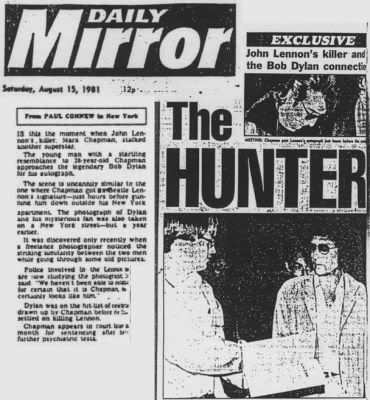
Incidentally, loser assassin Michael David Chapman may have been stalking a different victim 12 months earlier:


Cardboard Boxes is about moving house, as already stated, a nice semi-acoustic number with some great drumming.

Screaming Issue is a song written to Loudon's daughter by the singer Suzzy Roche (member of the family vocal group The Roches), who was born (judging by the song's lyrics) the previous Christmas. There would be another daughter (Lexie Kelly) by another woman later, so that it is sometimes difficult to be sure who these Wainwrights are singing about (Rufus has said that "Little Sister" is not about Martha, so is it about Lucy or Lexie?) At least there is no mistaking for whom this song is intended as Loudon mentions Lucy by name. The title puns, of course, on two senses of "issue." Delicate and beautiful.

Next we have one of Loudon's edgy funny songs, about the questions journalists always ask anyone who still has the temerity to outstay their welcome in the music business: How Old Are You?

The questions range from the nasty and impertinent:

How come you don't try to write a novel?
How come you don't try to write a play?
Isn't it time you died or retired?
Why the hell won't you just go away?
How old are you, are you crazy?
How old are you, are you really a drunk?
Are you bitter, have you grown lazy?
Were you embarrassed about "Dead Skunk"?


to ones that Loudon probably wonders about himself:

How come you didn't get big like Bob Dylan?
How come you didn't get big like Springsteen?
Were you unable or were you unwilling?
Tell us the truth about it, come on, come clean!


(Nice guitar by Richard Thompson, by the way!)

Then there is the utterly charming Animal Song, about the noises that animals make. A children's song. I don't trust the performer who never records at least one of those. Here's Loudon performing the song (followed by 'Five Years Old) live in 1987:


Out of This World is a hopeful song looking forward to the next life. Daddy Take A Nap is a slightly annoying brass band stomp with mildly amusing lyrics written from a child's point of view. Ready or Not (So Ripe) is an optimistic sounding song I've never got my head around.

The album closes quietly with Career Moves, which looks back over Loudon's career in the music business and as an entertainer with a lot of quiet pride:

For 20 odd years I have strummed on guitars
5,000 lost flat picks, four fingertip scars
I must have broken a million g strings
Picking and strumming, and playing these things
Banging and tunin', and playing these things.

And it's been 16 years now that I've written songs
Over a 100 and still growing strong
About drinking and hockey and flying above
Again and again about unhappy love
Over and over, unhappy love.

And it's music for money, but I'll do it for fun
Oh, I know how to do it, it's easily done
To stand on a stage doesn't make me afraid
I'm comfortable up there, it's gotten me laid
It always amazes me when I get paid.

So here am I doing all that I can do
You're paying, I'm playing, I'm grateful to you
Indoors and outdoors, at home and abroad
I sing these songs and you people applaud.
You haven't changed much, you still applaud.


With that obvious cue to the audience in the last line, it will be seen that the album is framed by two songs that seem written to order for Loudon's live shows. Moreover, "Career Moves" is Loudon's answer to some of the questions the hostile journalists ask in How Old Are You?, in particular, why he still sings and why he won't quit the business.

Here's Loudon singing "Career Moves" live on British TV in 1993:


You'll have to supply the applause yourself on cue!

I'm Alright was nominated for a grammy. It goes without saying that it didn't win...

Note: Scandalously, this fine album appears at time of writing to be out of print, with Amazon.com asking nearly $50.00 for a second-hand copy! Ordinarily I would not recommend that anyone download an mp3 copy of the album (that's against the whole ethos of these threads, which aim to present the artistic integrity of the LP/CD medium), but should you wish to support the artist, you can do so here: http://www.amazon.com/Im-Alright/dp/B000UDQ5VK/ref=dmusic_cd_album

Friday, 13 June 2008

Euro 2008: Russia sunk by Villa hat-trick

Russia's first effort in the European championship was a complete flop. In the match against Spain, Gus Hiddink's charges showed some fairly bold play before the break, but four times were caught in a counter-attack and lost (1:4). Our team's "gravedigger" was centre forward David Villa, who scored the first hat-trick of the championship.

It was as if four years had not passed. The same June heat, the same fire-breathing asphalt on the approach roads to the stadium. And once again Russia v Spain in the first Euro match for our team. Only then it was Faro, Portugal on the edge of the Atlantic Ocean, while this time it was the Alpine city of Innsbruck. The white, blue, and red sea of Russian fans this time exceeded the 10,000 of 2004. Though this time UEFA had allocated them only 6,000 tickets per match in the group phase of the tournament.

What were they counting on, the one-half of our compatriots who came to Austria without any guarantee of getting into the stadium? Some of them reserved places in the bars of Innsbruck and Salzburg, resigning themselves from the outset to watching the match on the big screen. But many were prepared to pay any money just to support the team from the stands of the Tivoli-Neu arena. It was they who became the hunted targets of enterprising Austrians who were prepared to cede to them their coveted tickets. Not, of course, for free.

Surely the touts aren't already asking a thousand Euros a ticket?!", a fan wearing a Zenit [St. Petersburg football team] shirt asked Izvestiya's correspondent. I could console him only partly - on the day before touts wandered into the tiny resort of Leogang demanding "only" 400-500 Euros a ticket. However, judging by my interlocutor's wild eyes, it would scarcely have been possible to frighten him with any price. One way or another, when the teams came out onto the field, even a fleeting glance at the stands was sufficient to understand that the Russian fans in Tirol were not outnumbered by the Spanish contingent.

But 90 minuties before the match a thunderstorm broke out over Innsbruck, and almost at the same time the rain gushed down in torrents. Passions in the covered stands did not cool. On the other hand, the simulation of the circumstances with the Portugal sourroundings, where the same rivals had to play in fatiguing heat. Our team has changed out of recognition in the intervening four years. Among the players in yesterday's term only Dmitriy Sychev took part in the match in Faro, spending only 22 minutes on the field.

Our team's starting line-up was by and large put together by Gus Hiddink literally within the past three weeks. It was given its dress rehearsal was in the 2-1 victory over Serbia. Compared with that game, there were just two changes to Russia's team. The injured Pogrebnayk's place in the attack was taken by the "resurrected" Pavlyuchenko, while on the right wing Bystrov was replaced by the aforementioned Sychev.

The Russian grandstands had also prepared thoroughly for the game. During the performance of the national anthem, alongside portraits of the current team members appeared photographs of the national heroes who won the first European cup in 1960. For several minutes before the Austrian ref Konrad Plautz blew his whistle, a veritable landing party disembarked at Tivoli-Neu. A khaki-coloured helicopter landed in the grassplot near the main stand, from which emerged Moscow Mayor Yuriy Luzhkov and his wife Yelena Barturina into the VIP stand.

The game had scarcely begun when our players had the Spanish sections of the crowd whistling in dissatisfaction. Our technical rivals for a long time could not get to the ball, so well did Huudink's charges control it. But the Spaniards did not need to manoeuvre much to open their account. The super-duo of Spanish forwards Torres and Villa scored a goal on the first counter-attack. Torres outmanoeuvred Kolodin, one of the central pillars of our rehashed defence, while Villa turned home his perfect pass.

No, our team didn't even think of giving up. Under the banner in the stands, "We need a goal!!!', it continued to besiege Casillas's goal-line. Before the break there was also Zyryanov's strike that hit the post, a dangerous free-kick earned by Zhirkov and taken by Pavlyuchenko, but... Yet another counter-attack by the Spanish caught the Russian team's defence by surprise. Iniesta wove a delicate pass between Anykov and Kolodin, and with a single touch Villa completed the double—0:2.

Thus the first half left an ambiguous impression. On the one hand, the Russian team gave not even a hint of being resigned to their fate or playing for a draw at most. On the other hand, in the first 45 minutes of yesterday's game the Spaniards scored twice as many goals against us as in the first 90 minutes in the previous European Championship.

After the break the game continued along roughly the same lines, the one difference being that the Russians' mistakes in defence were even cruder. And the Spanish did not fail to take advantage of them twice more; Pavlyuchenko managed only to score a consolation goal.

Translated from Izvestiya, 12th June, 2008 http://www.izvestia.ru/Russians/article3117286/

Wednesday, 11 June 2008

More on Bob Dylan in Russia (with mp3s)


Left: Falconet's statue of Peter the Great, who built St. Petersburg as his "window on the West."

For the first time in 30 years I am able to combine my day job (as a translator of the Russian press) with one of my main hobbies (appreciation of the music of Bob Dylan). So to follow up on my blog the other day, in which I translated the review of a highly perceptive Russian beat fan, here is a look at what the Russian press had to say about Bob's recent concert in St. Petersburg.

Right: bootleg art by StewART.

It was Peter's city, or rather the great poem about it by Alexander Pushkin, "The Bronze Horseman", that inspired me to take up the learning of Russian 30 years ago. Peter built his city in spite of nature, at an enormous cost in human life, as his "window on the West" through which he hoped Western culture would pour, enabling him to rouse up Mother Russia from what he perceived as her oriental backwardness, symbolised in Falconet's statue (above left) by the snake beneath the feet of Peter's fiery steed as he rears it up before the abyss on its giant pedestal, the Thunderstone, sometimes said to be the largest stone ever moved by man. To this day "Peter", as the city was known to its habitants even in Soviet times when it was officially named Leninngrad, remains the most Western of Russian cities, and hence, as the Russian website fontaku.ru notes, much more suited to Bob Dylan than the "white stone city" (i..e. Moscow), where Bob performed three songs at an invitation-only poetry festival way back in 1985.

The Russian press is, as regards youth culture, like the British and American press of 40 years ago; it claims to speak for the fans, but rarely makes any attempt to canvass their opinion. Whereas the admirable beatgene stated quite clearly that she hadn't expected Bob to perform her favourite songs, Kommersant (one of the few bastions of independent journalism remaining in Putin's Russia) assumes that the fans had been expecting the most familiar Dylan songs, and that Bob was guilty of showing contempt for the St. Petersburg public by not performing them.

The setlist looked as if the the maestro had no idea of where he was playing, or before whom. Or else he sincerely and entirely didn't give a damn. Fans of Paul McCartney, for instance, have seen him perform twice already on the territory of the former USSR, and only now are able to permit themselves to timidly ask the idol to play at his concert in Kiev on 14th June one or two things apart from a gentlemanly selection of "greatest hits." From the point of view of world culture, Bob Dylan is a figure of equal weight, but he was performing here for the first time since 1985, for the first time since an unsuccessful performance before an ideologically irreproachable and absolutely indifferent audience at an evening of world poetry that was timed to coincide with the Festival of Young People and Students in Moscow. To all intents and purposes, the concert in the Ice Palace was his first proper performance in this country. And he comes onto the stage and sings the following collection of songs:

"Cat`s in the Well" from the 1990 album Under the Red Sky. "Don`t Think Twice, It`s All Right" and "Girl of the North Country" from The Freewheelin` Bob Dylan (1963). "Honest with Me" from "Love And Theft" (2001). And seven of the 10 songs on the 2006 album Modern Times.

No one expected Mr. Dylan to perform a programme consisting only of songs from his "best of" collections; clearly he is still promoting his universally very well received album "Modern Times". But take the 2007 three-CD collection "Dylan", a more thorough compilation than many "best of" CDs, based as it is not just on the sixties golden period. Of the songs enumerated above, only one is on this compilation—"Don't Think Twice, It's All Right." In other words, for his début in Russia, Mr. Dylan chose songs that aren't too well known anywhere in the world.

At least that was the concert blueprint by and large: to play the little-known and completely new. But he nevertheless did offer a few of his calling cards. "Just Like A Woman" and "Highway 61 Revisited" were there, and the final number was the song that comes to mind when you figure out how Bob Dylan should end his concerts—"Like A Rolling Stone. But if "Just Like A Woman" was performed with at least some kind of hint at the possibility of singing along with it, the two other hits were played as if deliberately without even the most minimal hook that an audience wishing to express their respect for a classic could latch on to.

This quality of "podpevayemost'" (literally 'being able to sing along with') appears important to Russian audiences: beatgene herself mentioned being surprised and disconcerted by its absence. Is this what one goes to rock concerts for in Russia? To sing along with the songs just as they are on your records (or illegal downloads, more likely) at home? At any rate, this is not a quality that many songs as performed on the Never Ending Tour, or at any other stage in Bob's career, have had. He is not interested in being "the legend", or in the Russian phrase, "a classic" demanding respect, but in recreating his songs according to his current whim. Nevertheless, as this is likely to be his one and only performance before a Russian paying audience, I can't help wishing that for once the old bastard had been willing to acknowledge where he was and meet the audience half way. Russians do have an almost religious reverence for poets and performers, and they do like to indulge this bardolatry wherever possible. Their troubled history of the Russian people has meant that artists and poets in Russia have always carried the burden that Bob shook off early on in his career; that of expressing the true thoughts and feelings of the people. But they revere the poet for his words, not for his fame or whatever goes on in his private life. Should Bob have forgotten the lyric sheets that of late have become a fixture on his keyboard, there is little doubt that the entire audience would have been able to prompt him, in thick Russian accents, of course, just as readily as they did me when, at some dinner party or other in Moscow 20 years ago, I attempted to recite a poem by Aleskandr Blok while fully loaded on bootleg vodka and forgot some of the words. Everyone in the room joined in reciting the long dead poet's words.

Just who was the audience for this particular show, apart from beatgene and her fellow beat fans, as we have seen? According to fontaku.ru it was

a curious symbiosis of members of the older generation and young people. There were hippies and kids in trendy gear. What didn't happen was any sense of a "crowd." It was perfectly obviously that each of the spectators had his own Dylan, his own history of relations with his songs, it was impossible to speak of any kind of mass concert ecstasy. The audience was predominantly male, and the women were from the intelligentsia category. There were no "dumb blondes." Many spectators, with serious-looking faces, whispered the words of the songs in English; there were quite a few foreigoners. You would thing that such a tedious concert would quickly become boring; after all, nothing was happening outwardly on state; but there was in both a musical and poetic sense. internal drama. The sound was not loud; it was even like chamber music; but the band played with impeccable style. And for a man of 67, Dylan sung very well: the timbre was clear, the voice strong, even, and far more powerful than on the records.

A rather tepid review; and yet, considered as just another show by the modern Bob Dylan, the St. Petersburg concert was actually pretty good, on the evidence of the already circulating recording by the ubiquitous taper who goes by the name of Bach (hence the inevitable "Bach in the USSR" jokes). As on the US and Canada leg of the tour, Bob is in very good voice, and the performances are anything but indifferent. The band is even coming to life a bit, with noticeably more dynamic solos by Denny Freeman. Although it would be stretching things to suggest that the setlist was in any way tailored toward the audience, it's possible to imagine that Girl of the North Country was chosen as a tip of the hat to the "Venice of the North", as the city of Peter the Great is often called, or even to the name of the venue itself. And Workingman Blues #2 would have struck a chord with many in a nation that has gone from a drab, but equitable socialism, to an unbridled form of capitalism in which the rich are very wealthy indeed, and the poor can barely make ends meet. The buying power of the proletariat has certainly declined since Soviet times (when there was nothing to buy, but all necessities were dirt cheap). Modern times in Russia are very hard for a large percentage of the population.

Nevertheless, Tangled Up in Blue was in the setlist as if to remind everyone that Russia was just "another joint" on Dylan's endless road (or it could be because it was one of the songs written under the influence of Dylan's Russian-born art teacher, the mysterious Norman Raeben; or even just because it is the only Dylan song that mentions revolution!). It's a shuffling, bluegrass-tinged version with some new, somewhat half-baked lines:

He drifted down to New Orleans where he was lucky enough to be employed
Three times on a sailing boat, three times it was destroyed

Ouch. Rather better are:

She was working in "the Tropicana"
I stopped there for a beer
I
told her I was goin' on later (?)
She said, "I'm gonna stay right here."


Bob whips out the ol' harmonica before and after the last verse. Altogether a more enjoyable version than some of the breakneck versions of the recent past.

Other songs worth mentioning are Just Like A Woman, well sung with a lengthy harmonica intro; a smouldering rendition of It's Alright, Ma (I'm Only Bleeding) (Russians need no reminding that "propanda, all is phony"), with Dylan's keyboards maybe higher in the mix than usual; and a mesmerising Ain't Talkin'.

Here are some mp3s, with thanks to the aforementioned "Bach":

Girl From the North Country

Tangled Up in Blue


Just Like A Woman

It's Alright, Ma (I'm Only Bleeding)

Workingman's Blues #2

Ain't Talkin'


Thursday, 5 June 2008

One fan melts Bob's 'icy' heart in St Petersburg

I've just been reading a fan review of Bob's first ever performance in Russia (barring an appearance at a Moscow poetry festival in July 1985 that was not open to the general public) on Tuesday night and did a little translation to keep my hand in.

[I'll skip the first few sentences; the writer of the review (who blogs on Live Journal under the name beatgene) is part of St. Petersburg's beat scene (Beatles and Kinks fans), and the first couple of sentences are about her arriving at Ledovyy (the Ice Palace) well before the start of the show and meeting up with other people she knew from her Beatles forum. She sounds a really sweet girl; a shame Bob couldn't have been be a bit more responsive to his Russian fans.]

They were allowed in at 7pm: "I was in the second row of the orchestra stalls, pretty cool. But this is where the bewilderment started—the crowd didn't particularly increase. That is to say, there were around 150 of us standing in the stalls with the proverbial one-and-a-half cripples. By the start of the concert, we were feeling awkward about the far from full hall. Heck, Bob Dylan himself has come! For the one, and most likely, the only time. The entire Ledovyy department that was involved in promoting the concert should be fired as effing useless. Along with the security, who, seeing me focusing my camera lens on the as yet empty stage, sternly reported that photographs were strictly forbidden, all complaints [should be made] to the organizers. "Carry on taking pictures for now, kids; but when the concert starts, you won't be allowed to continue."

And now about Bob.

I'm a clever cookie, I don't think I expected from him fiery speeches, shouts of "Hiya, kids!", and the songs of his I love. The one thing I didn't count on was that he would change the arrangements of some numbers so much. No, they sounded good. Interesting. Only in places, unrecognisable; it was possible to sing along only with Just Like A Woman and Like A Rolling Stone. Well, for me anyway.

As everyone knows by now, Bob played only keyboards and harmonica.

Setlist:

1. Cat's In The Well (Bob on keyboard)
2. Don't Think Twice, It's All Right (Bob on keyboard)
3. Rollin' And Tumblin' (Bob on keyboard)
4. Tangled Up In Blue (Bob on keyboard)
5. The Levee's Gonna Break (Bob on keyboard)
6. Girl Of The North Country (Bob on keyboard)
7. John Brown (Bob on keyboard)
8. Honest With Me (Bob on keyboard)
9. Just Like A Woman (Bob on keyboard)
10. It's Alright, Ma (I'm Only Bleeding) (Bob on keyboard)
11. Workingman's Blues #2 (Bob on keyboard)
12. Highway 61 Revisited (Bob on keyboard)
13. Spirit On The Water (Bob on keyboard)
14. Summer Days (Bob on keyboard)
15. Ain't Talkin' (Bob on keyboard)
(encore)
16. Thunder On The Mountain (Bob on keyboard)
17. Like A Rolling Stone (Bob on keyboard)

There was a tense atmosphere; either Bob was tired or didn't especially like the St. Petersburg public. I didn't fully understand it, but he smiled little, spoke even less, came out for one encore, bowed, and left. And for the first time I clearly understood right away that they wouldn't return [for a second encore]. Even with Chuck Berry I had some hopes.

But this time... I don't even know what the reason was, whether it was general tiredness from concert performances, the far from full hall, or some other reason.

But all the same he's a big shot. All the same, he's a legend. And people love him. Standing nearby us were a little group of sweet Italians who devotedly follow Dylan round all the towns where he plays—real fanatics. Probably Russia appearing on his itinerary surprised them a bit!

And they still wouldn't let me take pictures. I thought that I 'd got into position successfully—the security man in front of me didn't see, I started snapping without a flash. It should have worked out fine. But it turns out, they [security] rushed down from the stage area. As a result, a security guy managed to get to me from behind and politely invited me to stop.

A few shots remained. I feel ashamed about showing them, of course, but what can you do—there won't be another time, as I understand. No, I didn't take them on a cell phone.


Well, that is that. My impressions are truly mixed. They don't fit into the usual rubric of liking or not liking something. I went to see Bob Dylan. I saw him. And I'm very happy indeed with this. Thanks to him for coming. And thanks to infobeat [name of another Live Journal blogger] for getting Bob to make a peace sign in his direction. It melted his icy heart. [There is a pun here on the name of the venue, of course].


Well, beatgene, that's a nice review, and your photos are nothing to be ashamed about. I hope you don't mind me showing them here. I hope this translation is okay, I'm a bit out of practice with colloquial Russian; I haven't translated anything but financial and legal documents and technical specifications for a long time!